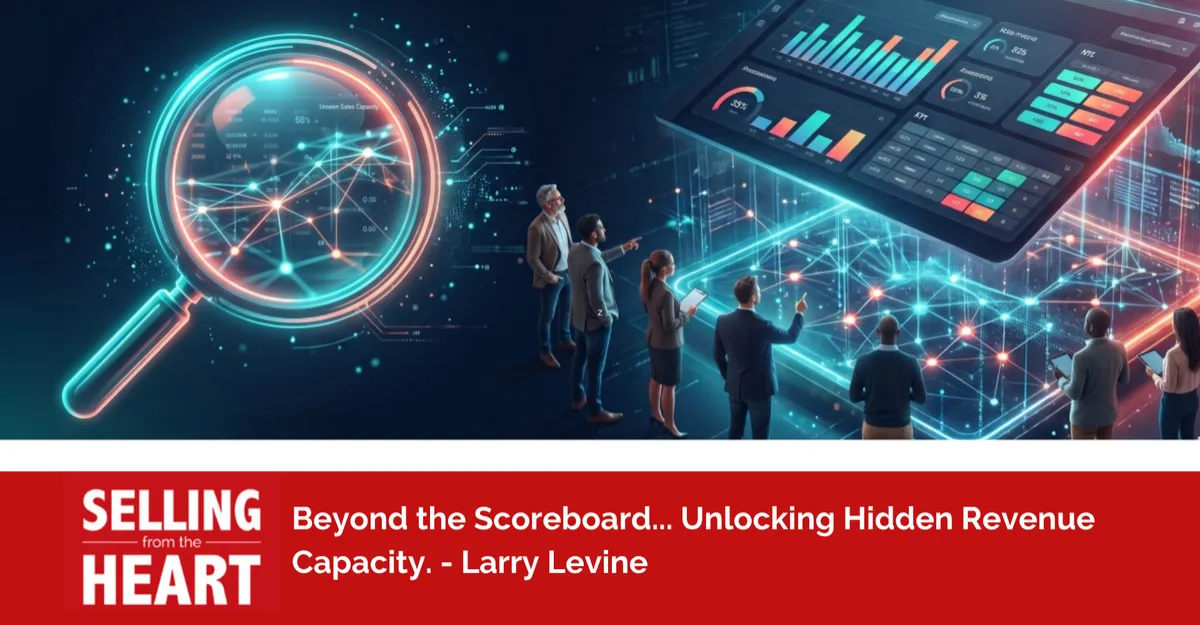
Beyond the Scoreboard... Unlocking Hidden Revenue Capacity.
“When you change the way you think about data, you change the way you run your business... It’s about unlocking hidden insights and potential.”
Satya Nadella, CEO of Microsoft
When you change the way you think about data, you change the way you lead your business and your salespeople.
For CEOs and Presidents, your sales team's data is more than a collection of numbers on a dashboard or a computer screen, it’s a window into untapped revenue, missed opportunities, and the potential hiding not only within your existing customer relationships, but deep within your salespeople.
Beyond forecasts and quota attainment, the right insights can reveal why deals stall, where win rates are slipping, which prospecting activities create meaningful conversations, and where your team could be enhancing their performance.
The question isn’t simply whether your sales team is hitting their numbers; it’s whether you understand the behaviors, mindset, heart set, relationships, and decisions driving those numbers.
When you move beyond reporting results to uncovering the story behind them, you gain the clarity to make smarter decisions and lead with greater confidence.
The real opportunity is turning those insights into action.
Can you imagine using data to unlock the performance of your salespeople, and to recognize the habits that consistently produce profitable growth?
As a CEO or President, you don’t need your team to simply work harder or make more calls, you need them working smarter, focused on the right opportunities and the right conversations.
When you unlock the potential in your sales data and align it with the human side of selling, you create more than better sales performance, you build a predictable, sustainable engine for revenue growth.
I ask you to think about this... What if your greatest revenue opportunity isn't asking your salespeople to do more, but understanding what prevents them from doing better?
Let's put your thinking cap on for a minute, and imagine you're the CEO of a professional sports franchise.
You've invested millions of dollars in talent, coaching, technology, and facilities. You have sophisticated analytics tracking performance, identifying patterns, and helping athletes make better decisions.
Every game generates information that can be used to improve the next performance.
You wouldn't evaluate your entire team by looking at the final score and telling your athletes to score more points, you'd want to understand what creates the results.
Why does one athlete consistently execute under pressure while another struggles?
Why does one player recognize opportunities that others miss?
What skills need developing?
What beliefs or habits get in the way?
What does the coaching staff need to do differently?
Now, think about your sales team... You have revenue reports, CRM dashboards, pipeline reviews, win rates, quotas, and forecasts. You know who is hitting their numbers and who isn't.
You know where your business stands against its goals, but do you know what's actually driving the performance?
Do you understand why some salespeople consistently create opportunities, earn trust, protect margins, and grow client relationships while others struggle to produce the same results?
Do you understand what's preventing the people on your team from reaching their potential?
This is where sales analytics becomes a strategic leadership opportunity, not simply a reporting exercise.
Research from Objective Management Group (our SalesIndex partner), a firm specializing in sales force evaluations and sales-specific competencies, offers executive leaders a compelling reason to look beyond the scoreboard.
The Scoreboard Tells You What Happened, Data Helps Explain Why
Most executive teams are exceptionally good at measuring outcomes.
Revenue is either up or down, the pipeline is growing or shrinking, win rates are improving or deteriorating, and salespeople are either hitting, exceeding or falling behind budget.
Those measurements matter, but they are largely after the fact.
By the time a revenue shortfall appears in the monthly report, the underlying issues may have been developing for weeks or months.
Maybe the team hasn't been creating enough qualified opportunities
Maybe they're uncomfortable asking difficult questions
Maybe they struggle to reach decision-makers, differentiate their value, or secure commitment from everyone involved in a buying decision
The missed revenue is the outcome, the underlying behaviors and capabilities may be the opportunity.
OMG and SalesIndex approach sales performance through three broad competency categories... Tactical Selling Competencies, Sales DNA, and the Will to Sell.
Tactical competencies address the skills needed to sell effectively, Sales DNA examines beliefs and internal tendencies that can support or undermine selling behaviors, and The Will to Sell explores motivation and commitment to sales success.
Together, these categories help leaders investigate a more important question than whether someone is hitting quota... What capabilities, beliefs, and motivations are influencing this person's ability to perform?
OMG's 2026 criterion-validity study examined more than 3,000 salespeople and found statistically significant relationships between all three competency categories and on-the-job performance. Tactical Selling Skills demonstrated the strongest relationship among the three categories examined.
These findings are meaningful, but they also require perspective. Sales performance is influenced by numerous factors, including territory, market conditions, management, and opportunity quality.
An assessment cannot explain everything, however; the key takeaway is that sales-specific competencies provide measurable information about performance that revenue reports alone cannot reveal.
Source: Objective Management Group, "What Actually Predicts Sales Performance?" (2026).
For CEOs and Presidents, this introduces something extremely important... You may have more untapped sales potential than your current results suggest, but you need a better understanding of what's preventing it from emerging.
The Relationship Paradox, Your Salespeople May Be Likable Without Being Consultative
In its analysis of 9,516 salespeople evaluated in 2025, OMG found that 56% demonstrated strength in Relationship Building, while only 11% were strong in Consultative Selling.
For a moment, reflect and think about what that means for your company.
You may have salespeople who are friendly, responsive, dependable, and genuinely enjoyable to work with. Your clients like them, they maintain relationships, and they know the people inside their accounts.
Yet those same salespeople may struggle to uncover the business issues that create compelling reasons to buy, or more importantly, they may hesitate to challenge a client's thinking, ask questions that expose costly problems, or help a decision-maker see an opportunity they hadn't previously considered.
Relationships can open the door, while consultative capability helps your salespeople create meaningful business value once they're inside.
If your salespeople build relationships but struggle to sell consultatively, the answer isn't necessarily more relationship training, it may be developing their ability to ask better questions, uncover business challenges, communicate meaningful value, and help clients make confident decisions.
Imagine the difference between a salesperson who maintains a comfortable relationship and one who uses that relationship to help a client rethink an expensive business problem.
Both may be liked, only one may be consistently creating the conditions for strategic growth.
Mirror Moment... Are you measuring relationship activity, or are you developing the capabilities that turn relationships into business value?
The Value-Selling Gap
OMG's analysis of salespeople evaluated between 2023 and 2025 reported the following proficiency rates in Selling Value...
2023 - 34%
2024 - 32%
2025 - 34%
Its reported average Selling Value scores were 58, 56, and 55, respectively, across those years.
For a CEO, this raises an extremely important set of questions...
How many of your salespeople can clearly connect your company's capabilities to the business outcomes that matter most to your clients?
Can they quantify the cost of a problem?
Can they articulate the financial implications of inaction?
Can they help distinguish between the cheapest solution and the solution that delivers the greatest overall value?
When salespeople struggle to establish meaningful differentiation, conversations can drift toward price comparisons.
When salespeople understand the client's business and communicate meaningful value effectively, they have a better foundation for protecting margins and building more strategic relationships.
An increase in more meaningful value conversations can support revenue growth. It can also help improve the quality of revenue by reducing unnecessary discounting, while creating opportunities to solve more significant business roadblocks.
What might happen to your gross margin if your team became more effective at communicating meaningful value?
What might happen to win rates if clients better understood the business case for choosing you?
What might happen to client loyalty if your salespeople consistently brought meaningful insight rather than simply responding to requests?
Data, The Competitive Advantage
I believe the real opportunity emerges when executives stop treating these findings as isolated statistics and begin connecting them to growth strategies.
Let's tie this to two growth areas...
Growing New Business
If your objective is to acquire more ideal clients, look into the capabilities that influence prospecting, reaching decision-makers, qualifying opportunities, and creating compelling first meetings, then...
Are your salespeople consistently making time for prospecting?
Are they engaging the right accounts?
Are they building relationships across the buying group?
Can they create a credible reason for a prospective client to meet them?
Measure the quality of those behaviors alongside outcomes such as qualified opportunities, conversion rates, and new-client revenue.
Growing Existing Business
If your objective is to increase revenue from current clients, examine the capabilities that influence account management, consultative selling, value communication, and relationship development.
Do your salespeople understand the client's evolving priorities?
Do they have relationships with multiple decision-makers and influencers?
Are they uncovering unmet needs and identifying opportunities to create additional value?
Connect those behaviors to account penetration, client retention, expansion revenue, and gross margin.
Your sales strategy may be sound, but your team may lack the skills to execute it.
Your salespeople may have the right capabilities, but your sales managers might not be reinforcing them.
Your challenge is to understand how the pieces fit together.
Questions Every CEO Should Be Asking
If you want to move beyond the scoreboard, start by challenging your leadership team's assumptions.
Do we know why our top performers succeed?
Can you and your leadership team identify the specific competencies and behaviors that distinguish your strongest salespeople? Or are you simply assuming that their results reflect superior talent, effort, or experience?
Look for repeatable practices that can be developed across the entire team.
Do we understand the root causes of underperformance?
When someone misses quota, do you investigate whether the issue is skill, belief, motivation, opportunity quality, management, or a combination of factors?
Avoid assuming every problem requires more activity.
Are our sales managers developing people or primarily inspecting numbers?
Do managers have the capability and time to coach specific behaviors? Do they know how to turn data-driven information into a practical development plan?
Your sales managers are one of the most important links between data and improved performance, turn them into coaches.
Are we building a repeatable revenue engine?
Can your team acquire new clients, expand existing relationships, protect margins, and develop sales talent without relying disproportionately on a handful of exceptional salespeople?
If not, you may have a performance opportunity that extends well beyond individual quotas.
Your Revenue Opportunity, Unlock Sales Performance
Elite sports teams don't study performance because they expect every athlete to become identical.
They study performance to understand individual strengths, expose blind spots, and help each athlete contribute more effectively to the team's objectives.
Your sales organization deserves the same level of attention.
OMG's research suggests that important selling capabilities including consultative selling and selling value, remain underdeveloped across substantial portions of the sales population it has assessed.
This doesn't mean every company has the same gaps, what it means is executive leaders have good reason to investigate whether similar opportunities exist within their own teams.
Imagine knowing where your strongest performers excel, why certain opportunities stall, and which skills or beliefs are holding back otherwise capable salespeople.
Imagine sales managers who coach with greater precision, salespeople who become more confident and capable, and clients who experience more meaningful conversations and stronger business outcomes.
Imagine growing revenue while protecting profitability, strengthening trust, retaining more clients, and developing the next generation of sales talent.
So, here's the question I'd leave with you... If you could uncover the hidden factors influencing your sales team's performance, what might you change?
What if the salesperson missing quota doesn't need more pressure, but a different kind of coaching?
What if your strongest relationship builders could become more effective at creating business value?
What if your team could identify the behaviors that improve win rates, protect margins, deepen client relationships, and create sustainable growth, then deliberately develop those behaviors across the team?
What if understanding those factors gave you a competitive advantage your competitors couldn't easily replicate?
The next breakthrough may be hiding in the capabilities of the salespeople you already have.
Stop managing only the scoreboard, and start unlocking the performance behind it.
The most important question isn't simply how much revenue your sales team produced last quarter, it's how much more capable your sales team could become and what that could mean for the future of your business.
Originally. published on Larry Levine's LinkedIn.